

The 6 Best Chronic Illness Apps of 2026 | Reviewed & Rated
Everything you need to know about the top apps for managing a chronic illness.
Looking for a quick answer? The best chronic illness app in 2026 depends on what your condition actually demands of you day to day. Bearable is the best all-round chronic illness app: it tracks symptoms, medications, mood, sleep, energy, and dozens of other factors in one place and shows you how they connect, which matters most when you’re managing more than one condition.
Visible is the best app for pacing if you live with ME/CFS, long COVID, POTS, or another energy-limiting illness. Guava is the best choice if your biggest headache is medical records and lab results scattered across a dozen patient portals. Migraine Buddy is the best example of a condition-specific tracker done well. MyTherapy is the best free option if medication is the hardest part of your routine. And Human Health is the best pick for families and caregivers who need to track more than one person.
A chronic illness app is a symptom and health tracker built for conditions that last a year or more and need ongoing management. At a minimum, it lets you log symptoms and their severity, record medications and treatments, and produce a summary you can show a doctor. The best ones in 2026 also pull in data from wearables, help you spot triggers and patterns, support pacing for energy-limiting conditions, and keep your data somewhere you’d be comfortable with.
Bearable is our own app, so we’ve put it first, but we’ve tried to be honest about where the other five options on this list do things better, and we’ve said plainly where Bearable isn’t the right fit. Nobody paid for placement here, and this article contains no affiliate links.
Key takeaways
- Best all-round chronic illness app: Bearable, because it connects symptoms, medications, mood, sleep, and triggers on one timeline, which is what multiple-condition management actually requires.
- Best for pacing (ME/CFS, long COVID, POTS): Visible, the only app here built around heart-rate-based energy budgeting rather than fitness goals.
- Best for medical records and labs: Guava, which imports records from 50,000+ US providers and includes that sync on its free plan.
- Best condition-specific tracker: Migraine Buddy, with 4.8 stars from 42,000 iOS ratings and neurologist-ready reports.
- Best free option for medication-heavy routines: MyTherapy, fully free and ad-free.
- Best for families and caregivers: Human Health, with multiple profiles and a generous free tier.
- The scale of the need: 76.4% of US adults had at least one of 12 common chronic conditions in 2023, and 51.4% had two or more, according to CDC researchers.
- New in 2025: Mount Sinai researchers found consumer wearables picked up changes in heart rate variability and activity up to seven weeks before IBD flares and up to four weeks before rheumatoid arthritis flares, a strong case for syncing your watch or ring to whichever app you choose.
- Privacy in 2026: most of these apps are not covered by HIPAA. Check where your data is stored, whether it’s ever sold, and whether you can export it.
A few things have changed since the last serious roundup of this category. Consumer health privacy law has moved from one state (Washington) to more than twenty, with New York’s bill revived in the 2026 session. Several apps on this list, including Guava and Migraine Buddy, have added AI features, which raises new questions about what your data trains and who sees it. And several apps that were staples of chronic illness communities two or three years ago have quietly stopped shipping updates, which is why “is it still maintained” is now one of our selection criteria.
Quick comparison: the best chronic illness apps at a glance
| App | Best for | Price | Platforms | Rating (iOS) |
|---|---|---|---|---|
| Bearable | All-round tracking across multiple conditions | Free; premium $6.99 to $34.99 | iOS, Android | 4.8/5 (6.3K ratings) |
| Visible | Pacing for ME/CFS, long COVID, POTS, fibromyalgia | Free research app; membership $14.99 to $19.99/mo; optional band about $80 | iOS, Android | 4.8/5 (3.5K ratings) |
| Guava | Medical records, labs, and symptoms in one place | Free; Premium $8/mo or $78/yr | iOS, Android, web | 4.8/5 (903 ratings) |
| Migraine Buddy | Condition-specific tracking (migraine) | Free; MBplus $9.99 to $12.99/mo | iOS, Android | 4.8/5 (42K ratings) |
| MyTherapy | Medication-heavy regimens, fully free | Free | iOS, Android | 4.8/5 (8.5K ratings) |
| Human Health | Families and caregivers, multiple profiles | Free; HumanPlus $4.99 to $6.99/mo | iOS, Android | 4.6/5 (373 ratings) |
Ratings and prices taken from each app’s US App Store listing or official pricing page in September 2026; see sources. Android ratings can differ.
How did we choose these apps?
Every ranking here is based on evidence we can point to, not sponsorship. We weighed five things: what each app’s official app store listing says it does and how it’s rated; independent coverage from health publishers and patient-community sites, including Health Rising for the ME/CFS and long COVID perspective [14]; the medical guidance behind symptom tracking and pacing, drawing on the CDC, Cleveland Clinic, Healthline, and peer-reviewed research [3] [4] [5]; how each app handles your data, based on its own privacy statements; and whether it is still actively maintained in 2026. That last test knocked out some well-known names. Manage My Pain, a long-standing pain diary, hasn’t shipped an iOS update since August 2024, and PatientsLikeMe’s app has just 18 ratings on the App Store with recent reviews describing it as too unstable to use, even though the website community behind it remains active [25] [26].
What should you look for in a chronic illness app in 2026?
Chronic illness apps vary more than almost any other health category, because the conditions do. Before you download anything, it’s worth deciding which of these six things matter most to you.
Whether it can hold your whole picture. If you live with one condition, a specialist app will often serve you better than a generalist. If you live with three, the app needs to track all of them, plus the medications, sleep, stress, hormones, and weather that affect them, on a single timeline. Otherwise you end up doing the correlation work in your head, which is exactly what you were trying to avoid.
Whether it finds patterns, or just stores entries. Healthline’s guidance on symptom journals is that their value comes from letting you and your doctor spot patterns and triggers, not from the record itself [5]. An app that only produces a list of dated entries is a notebook with notifications. Look for correlation reports, trend charts, and the ability to compare one factor against another.
Whether it supports pacing, if you need it. For ME/CFS, long COVID, and many people with POTS or fibromyalgia, the central task is staying inside an energy envelope to avoid post-exertional malaise. The CDC’s ME/CFS management guidance recommends activity and symptom diaries to find your limits and notes that some patients find heart rate monitors useful for this [3]. Most general trackers don’t do heart-rate-based pacing; Visible is built around it.
Whether your doctor can use what it produces. A clean, exportable report that shows severity over time is worth more in a fifteen-minute appointment than any amount of in-app charting. Bearable member Kayleigh, who lives with dysautonomia and PoTS, put it simply in her user story: “When I go to doctors I struggle with remembering everything I need to say to them,” and being able to show her progress in the app changed those conversations [20].
Where your data lives and who can see it. Most consumer health apps are not covered by HIPAA, which applies to providers, insurers, and their business associates, not to an app you download yourself. The FTC’s Health Breach Notification Rule now explicitly covers these apps, and a growing set of state health privacy laws requires opt-in consent before your health data is collected or sold [9] [11]. We cover this in detail below, because it’s the concern that comes up most often in chronic illness communities.
Whether you can leave. Chronic illness is long-term; apps aren’t always. Before you commit years of data to any app, check that you can export it in a usable format (PDF at minimum, CSV ideally). CareZone, once widely recommended to caregivers, was acquired by Walmart in 2020 and had vanished from the app stores within a year, according to Tech-enhanced Life’s review [36]; several other once-popular trackers have simply stopped shipping updates.
Why does tracking a chronic illness matter?
Chronic illness is the norm in the United States, not the exception. Cleveland Clinic summarises the picture as “about 6 in 10 people in the U.S. have at least one chronic disease, and about 4 in 10 have two or more” [4]. Newer CDC data suggests the picture is even broader: an analysis published in Preventing Chronic Disease in 2025 found that 76.4% of US adults (more than 194 million people) reported at least one of 12 selected chronic conditions in 2023, and 51.4% reported two or more, with the steepest rise among adults aged 18 to 34 [2]. The CDC also reports that 90% of the nation’s $5.3 trillion in annual healthcare spending goes to people with chronic and mental health conditions [1].
Managing more than one condition is where tracking earns its keep. The American Geriatrics Society’s Health in Aging Foundation estimates that as many as half of older adults don’t take medications as prescribed, and a big part of the reason is complexity: several conditions, several prescribers, and no single record tying it together [6]. The evidence for apps helping with the medication side is encouraging; Harvard Health summarizes a 2020 meta-analysis of nine randomized trials in which app users were about twice as likely to report sticking to their regimen, with the caveat that adherence was self-reported [7].
The strongest evidence that systematic symptom reporting changes outcomes comes from oncology. In a randomized trial of 766 patients on chemotherapy at Memorial Sloan Kettering, published in JAMA in 2017, patients who logged their symptoms through a simple web tool between visits lived a median of 31.2 months, compared with 26 months for usual care, because problems were caught and treated earlier [8]. Cancer is not the same as fibromyalgia or Crohn’s disease, and consumer apps aren’t clinical systems with nurse alerts. But the underlying mechanism, catching a change before it becomes a crisis, is exactly what people with chronic illness use these apps for.
There’s a quieter benefit too. Bearable member Jennifer, who manages migraines, ADHD, chronic pain, and suspected MCAS and Ehlers-Danlos syndrome, described in her story how seeing her symptom data laid out changed the way she judged herself: “now I look at my symptoms and I think, well everything’s red, of course I don’t get stuff done” [21]. For a lot of people, the first thing a tracker gives them isn’t a diagnosis. It’s evidence that what they’re experiencing is real.
What outcomes can you realistically expect from a chronic illness app?
These apps differ not just in features but in the kind of result they’re built to produce. It helps to know which outcome you’re actually after before you pick one, and to be honest about how strong the evidence is for each. Roughly in order of how well supported they are:
Better appointments. This is the most reliable payoff and the one every app on this list can deliver. A concise record of what happened, when, and how badly turns a vague “it’s been a rough month” into something a clinician can act on, which is exactly the value Healthline attributes to a symptom journal [5]. Bearable, Migraine Buddy, and Human Health produce appointment-ready PDFs; MyTherapy shares a report by one-time code; Guava adds your actual lab results and visit notes alongside your own entries. If you’re wondering whether a notebook would do the same job, a small 2025 randomized crossover study in people with advanced Parkinson’s found a smartphone diary was significantly more complete and accurate than paper, and two-thirds of participants preferred it [43].
Fewer missed doses. The best-evidenced outcome for any health app. Harvard Health’s summary of nine randomized trials found app users about twice as likely to report taking medication as prescribed [7]. A larger 2025 meta-analysis in the Journal of Medical Internet Research, pooling 14 randomized trials and 1,560 people with conditions from hypertension to Parkinson’s and psoriasis, found a meaningful improvement on the standard eight-item adherence scale and, where adherence was measured directly, an 18.9 percentage-point gain [42]. MyTherapy is the strongest pure reminder tool here; Bearable and Guava build reminders into broader tracking.
Fewer crashes and a steadier baseline. For energy-limiting conditions, the goal is staying inside your limits, and the CDC endorses activity and symptom diaries, and for some people heart rate monitoring, as the way to find them [3]. Visible is built around this outcome. Be aware that the evidence for heart-rate-guided pacing specifically is still developing; the CDC guidance describes it as something some patients find useful, not a proven protocol, and community reviewers have questioned how much a consumer wearable adds [3] [14].
Earlier warning of a flare. This is the newest and, for anyone with an inflammatory condition, possibly the most exciting outcome. In a 2025 study in Gastroenterology of more than 300 people with Crohn’s disease or ulcerative colitis, Mount Sinai researchers found that heart rate variability, heart rate, oxygenation, and activity levels recorded by everyday wearables (Apple Watch, Fitbit, Oura) began shifting up to seven weeks before a flare [40]. A companion study in Scientific Reports found the same signals changed up to four weeks before rheumatoid arthritis flares [41]. Two honest caveats: these were research analyses, not tests of any consumer app, and a pattern researchers can find in hindsight is not yet an alert on your phone. But it is a strong argument for choosing an app that pulls in wearable data, which Bearable, Visible, and Guava all do, and for keeping that data next to your symptom log so you and your clinician can see the two together.
Spotting triggers and judging treatments. This is what people most want and where expectations need the most care. Correlation reports in Bearable, Guava’s automatic insights, and Migraine Buddy’s trigger suggestions can surface patterns you would never see in your head, but a pattern in one person’s data is a hypothesis to test with your clinician, not a diagnosis. It also takes consistent input: a few weeks of daily entries before daily patterns are meaningful, and two or three cycles for anything hormonal.
Support on the road to a diagnosis. No app diagnoses anything, but a clear record can shorten the path. Bearable member Kayleigh describes her PoTS diagnosis following from heart rate data she was able to show her physiotherapist [20]. Bearable and Visible both capture heart rate from wearables; Guava keeps the lab results and specialist notes together.
Validation and a lighter mental load. This is hard to measure and easy to underrate. Seeing severity plotted over time is, for many people, the first external evidence that what they experience is real, and it takes the job of remembering off a brain that is often already dealing with fog. Jennifer’s account of reading her own data and stopping the self-blame is the clearest example in Bearable’s user stories [21].
Contributing to research. Visible’s opt-in studies with Stanford, Mount Sinai, and the Patricia Lee Research Center for ME are the most developed example here [27]. It is a real outcome for people who want their data to count for something, though it’s an outcome for the field rather than for you directly.
What no app will do. None of these will cure anything, replace your care team, or produce insight without input. And the input is the hard part: a 2025 systematic review in npj Health Systems of digital self-care tools for chronic illness found that declining motivation over time directly reduces adherence to tracking, with most studies too small or too short to show what works beyond a year [37]. The practical lesson is to start small. Track three to five things that matter most, let wearable data fill in the rest, and review monthly rather than logging everything and burning out in a fortnight.
The 6 best chronic illness apps of 2026
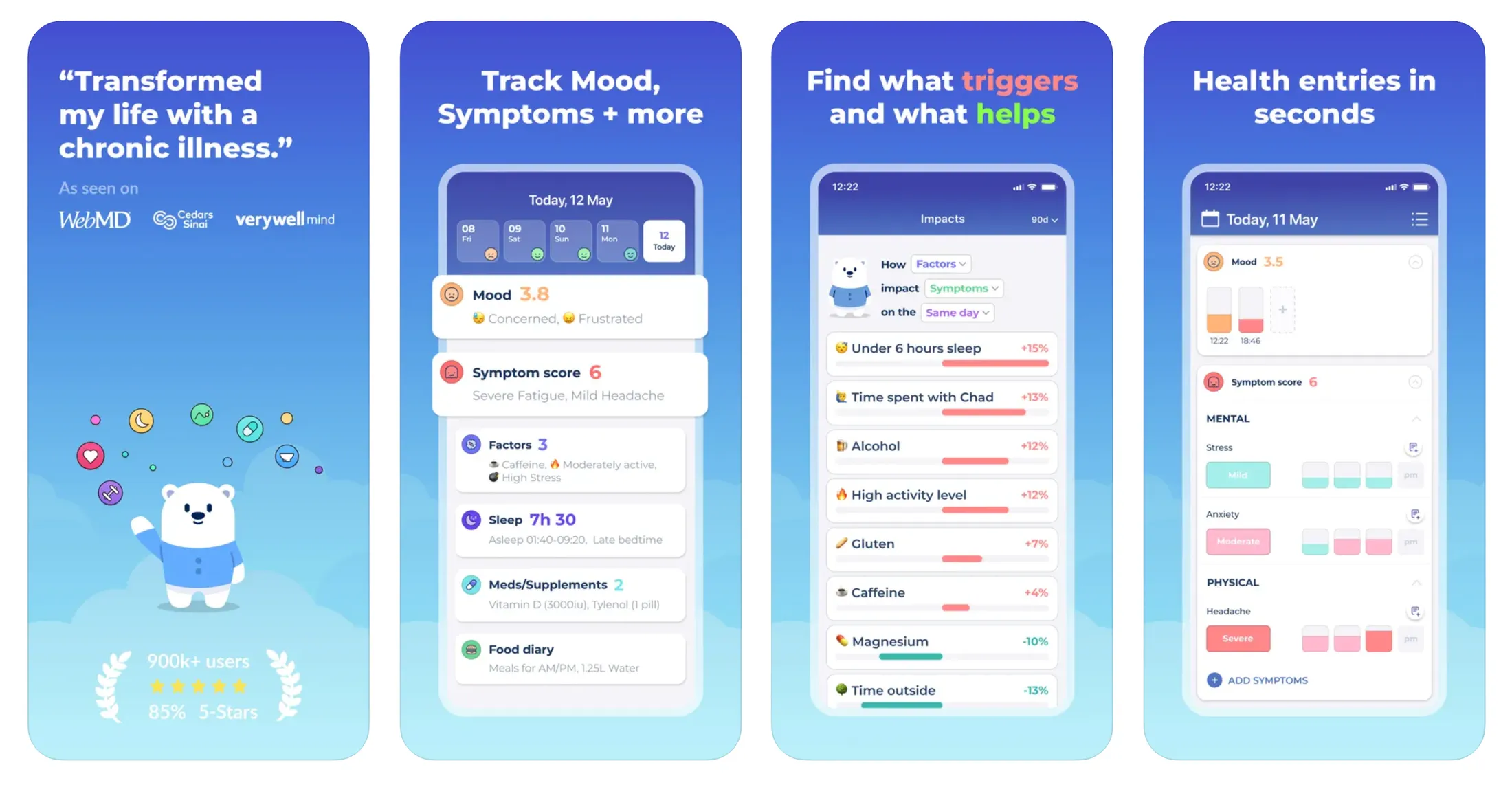
1. Bearable: best all-round chronic illness app
Price: Free; premium $4.49 to $49.99 depending on plan. Platforms: iOS, Android. Standout: correlates symptoms, medications, mood, sleep, energy, and triggers on one timeline. Based in: United Kingdom (GDPR).
Bearable describes itself as built with people living with PoTS, EDS, fibromyalgia, ME/CFS, and long COVID, and it shows in the design [19]. Rather than asking you to pick one condition, it lets you track unlimited custom symptoms alongside medications and side effects, mood, sleep, energy, food, activity, and a long list of potential triggers, from weather and barometric pressure to hormones, caffeine, stress, and social events, then shows you which of those factors correlate with changes in your symptoms [18]. It syncs sleep, heart rate, HRV, steps, and weight from Apple Health, Google Fit, and Fitbit, so a lot of the passive data arrives without you logging anything [18].
That breadth is the point for anyone with more than one diagnosis, where the real questions are cross-cutting: does the new medication help the pain but wreck the sleep, is the flare tied to the cycle, is this treatment actually doing anything [17]. Weekly reports, timelines, and comparison charts are built for exactly those questions, and everything exports as a doctor-ready PDF [18]. Bearable’s own survey data says over 90% of members report the app helps them understand their symptoms better; treat that as the company’s number, not an independent one, but it’s consistent with the 4.8-star rating across 6,300 App Store reviews [18] [19].
On privacy, Bearable is a UK company operating under GDPR. Its privacy policy opens with the commitment that it “does not and will never sell any personal data,” data is encrypted, and being outside US jurisdiction matters to some users for the same reasons it does in the period-tracking world [22]. Alia, who lives with several chronic conditions, described in her user story the shift from struggling to communicate what was wrong to having “all the data in one place” for analysis and for appointments [23].
Key features:
- Unlimited custom symptoms with severity, plus medications, side effects, mood, sleep, energy, and treatments
- Trigger and correlation reports across weather, hormones, food, stress, activity, and more
- Apple Health, Google Fit, and Fitbit sync for sleep, HRV, heart rate, steps, and weight
- Weekly reports, timelines, and comparison charts, exportable as PDF for appointments
- UK-based, GDPR, encrypted, no sale of personal data
- Recommended by Drs & Therapists and backed by medical review
Where it isn’t the best fit: if you have one condition with a well-defined set of variables, a specialist app like Migraine Buddy will get you a more tailored experience faster. If heart-rate-based pacing is the whole game for you, Visible does that in a way Bearable doesn’t attempt. And Bearable is designed for one person tracking their own health, not for a caregiver managing several people’s records.
2. Visible: best for pacing ME/CFS, long COVID, and POTS
Price: Free research app; Visible membership $19.99/mo or $179.88/yr ($14.99/mo); optional Visible Band about $80. Platforms: iOS, Android. Standout: heart-rate-based PacePoints energy budget with real-time over-exertion alerts. Based in: United States (Visible Health Inc.).
Visible is the one app on this list that starts from the assumption that doing less is the goal. Built by a long COVID patient and developed with heart-rate-based pacing protocols from the Workwell Foundation, it measures your morning HRV and resting heart rate with your phone camera, gives you a daily Stability Score, and, with a membership, sets a personalised PacePoints budget that tracks exertion through the day and warns you before you overspend [24] [14]. The optional Visible Band, a Polar-made armband, adds continuous heart rate so the budget updates in real time. The App Store listing shows a 4.8-star rating from 3,500 reviews and an app updated within the last day, and Visible partners with Stanford, Mount Sinai, and the Patricia Lee Research Centre for ME on opt-in research [24] [27].
This is the app the CDC’s pacing guidance is effectively describing when it talks about activity diaries, energy envelopes, and heart rate monitors, and the community reception reflects that: one long-term user quoted in an independent July 2026 review said the band “makes me pace more; the pace points are everything” [3] [15]. The criticism is just as consistent. The subscription stacks on top of hardware you’ve already bought, which readers on Health Rising and elsewhere have called hard to justify on disability income; the band is reported to unpair often and cause skin irritation for some wearers; and a few users conclude after a year that it is, at heart, a heart rate monitor with a good interface [14] [15].
Key features:
- Morning HRV and resting heart rate via phone camera, with a daily Stability Score
- PacePoints energy budget and real-time over-exertion alerts (membership)
- Optional Visible Band for continuous heart rate (US and UK)
- Symptom, medication, and activity logging with exportable reports
- Opt-in research participation with academic partners
Pros vs Bearable: purpose-built pacing that Bearable doesn’t offer, continuous heart-rate integration through its own band, and a research program specific to energy-limiting illnesses.
Cons vs Bearable: materially more expensive once the membership and band are combined, narrower in scope (it’s about exertion, not the full picture of triggers, mood, and treatments), and dependent on a wearable some users find unreliable or irritating.
3. Guava: best for medical records, labs, and symptoms in one place
Price: Free; Premium $8/mo or $78/yr, with a discounted family plan. Platforms: iOS, Android, web. Standout: imports records from 50,000+ US providers via patient portals and reads lab results from photos and PDFs.
If your chronic illness has left you with logins for six patient portals and a folder of lab PDFs, Guava is the app that tidies that up. It connects to more than 50,000 US providers to pull in visit notes, medications, and lab results automatically, extracts values from uploaded documents, and lays them next to your own symptom logs, wearable data (Apple Health, Fitbit, Garmin, Oura, Dexcom, and others), and medication reminders [28]. The App Store listing shows 4.8 stars from about 900 reviews, and the Android version was updated in May 2026 [28] [39]. Guava’s pricing page puts records sync, device sync, and basic trends on the free plan; Premium adds automatic insights across all your data, unlimited profile managers for families, an emergency card, and an AI assistant for preparing doctor visits [29].
Guava says it follows HIPAA, GDPR, and applicable state law, does not sell data, and leaves sharing under your control [29]. It’s worth understanding what “follows HIPAA” means for an app you download yourself, which we get into in the privacy section below. The other honest caveat is that the record import is US-only, so the headline feature does nothing for readers outside the country, and the iOS app’s last update was August 2025 at the time of writing, which is longer than we’d like even though the Android build is current [28].
Key features:
- Automatic medical record and lab import from 50,000+ US providers
- Lab result extraction from photos and PDFs, in multiple languages
- Symptom and pain tracking with a body heat map; period, fertility, and pregnancy tracking
- Syncs Apple Health, Fitbit, Garmin, Oura, Dexcom, and more
- AI summaries of doctor notes and visit prep (Premium); web app included
Pros vs Bearable: the records and labs integration is something Bearable simply doesn’t do, the device list is longer, and a web app helps anyone who prefers a laptop.
Cons vs Bearable: symptom tracking is broader than it is deep, with less emphasis on triggers and cross-factor correlation; the core feature is US-only; and the iOS release cadence has been slower than the rest of this list.
4. Migraine Buddy: best condition-specific tracker
Price: Free; MBplus $9.99 to $12.99/mo or about $70 to $90/yr. Platforms: iOS, Android. Standout: attack-by-attack recording with neurologist-ready reports and a 3.5-million-member community.
We include Migraine Buddy for a reason that applies well beyond migraine: sometimes the best chronic illness app is the one built for your exact condition. With 42,000 App Store ratings at 4.8 stars, a claimed four million users, and an update within the past week, it is the most widely used single-condition tracker in the category [30]. Each attack record captures triggers, symptoms, medications, and duration; the app pulls in sleep from Apple Health, Fitbit, Apple Watch, and Oura; and it produces diary and MIR-format reports designed for neurologists, which reviewers repeatedly say have helped in appointments and in disability claims [30].
The trade-off is the same one every specialist app carries. If migraine is one of several things you’re managing, Migraine Buddy has nowhere to put the rest, and its premium tier is among the priciest here. The Google Play listing states that data is encrypted in transit and not shared with third parties, which is a clearer statement than many apps make [31]. The developer is Aptar Digital Health, a healthcare company rather than a consumer-app startup.
Key features:
- Detailed attack recording with trigger, symptom, and medication capture
- Sleep tracking from Apple Health, Fitbit, Apple Watch, and Oura
- Weather and pressure forecasts tied to attack risk
- Doctor exports in diary and MIR formats
- Community forum and MBplus coaching programs
Pros vs Bearable: deeper migraine-specific detail, a very large peer community, and report formats neurologists already recognise.
Cons vs Bearable: single-condition by design, a higher premium price, and no way to see how migraine interacts with your other diagnoses, medications, or mood.
5. MyTherapy: best free option for medication-heavy routines
Price: Free, no ads. Platforms: iOS, Android. Standout: medication reminders plus a health diary and doctor reports shared by one-time code. Based in: Germany (GDPR).
For a lot of people with chronic illness, the hardest daily task isn’t logging symptoms, it’s getting eight medications taken at the right time. MyTherapy is the best free tool for that job. It’s free on both platforms with a 4.8-star rating from 8,500 App Store reviews, pairs reminders and refill alerts with a diary of blood pressure, weight, blood sugar, mood, and symptoms, and generates a report you can share with a clinician via a one-time code rather than handing over your account [32]. It has stayed ad-free while several competitors have not. We reviewed it in more depth in our best medication tracker apps of 2026 roundup [33].
As a chronic illness app it’s narrower than it looks. The symptom diary exists to support the medication record, so it’s weak at the trigger-hunting and cross-factor pattern work that people with multiple conditions tend to need. Think of it as the best possible medication layer, not the whole system.
Key features:
- Medication and refill reminders with automatic intake documentation
- Health diary covering 20+ measurements and symptoms
- Secure one-time-code report sharing with healthcare providers
- Siri Shortcuts and Apple Health integration; fully free and ad-free
Pros vs Bearable: completely free, and the medication reminder and refill experience is more refined than Bearable’s.
Cons vs Bearable: little in the way of trigger analysis or correlation; symptom tracking is a supporting feature rather than the core.
6. Human Health: best for families and caregivers
Price: Free; HumanPlus $4.99 to $6.99/mo or $39.99 to $54.99/yr. Platforms: iOS, Android. Standout: multiple profiles, a 2,000-symptom library, and a free tier with no paywall on essentials. Based in: Australia.
Human Health earns its spot on two counts. First, it lets you create profiles for several people, which makes it the practical choice for a parent tracking a child’s condition alongside their own, or a caregiver managing a partner’s. Second, its free tier is unusually generous: unlimited symptom and treatment tracking, reminders, vitals, and PDF reports without a paywall, with HumanPlus adding lab storage, custom doctor reports, and multi-pattern insights [34] [16]. The App Store listing shows 4.6 stars from 373 reviews and an update within the past week, and users in an independent July 2026 review singled out that it doesn’t “excessively restrict these amazing tools” behind subscriptions [34] [16].
The limitations are proportionate to its size. Correlation and treatment-comparison tools are thinner than Bearable’s; there’s no way to distinguish a skipped dose from a taken one, wearable integration is limited, and the Android version is rated noticeably lower than iOS with some login complaints [16]. It’s a strong, simple, honest tracker rather than an analytical one.
Key features:
- Multiple profiles for family members and dependents
- Symptom library of roughly 2,000 entries with severity ratings
- Medications, supplements, therapies, and vitals logging
- Customizable PDF reports for appointments
- Encrypted storage with user-controlled sharing
Pros vs Bearable: multi-person profiles, which Bearable doesn’t offer, and a very generous free tier.
Cons vs Bearable: weaker pattern and correlation analysis, limited wearable data, and a less polished Android experience.
Is your chronic illness data private in 2026?
This is the question that comes up most often when people in chronic illness communities compare apps, and the honest answer is: it depends on the app, and the law is still catching up. HIPAA, the federal health privacy law most Americans assume protects their medical information, applies to healthcare providers, health plans, and the companies that process data for them. It does not, in general, cover a consumer app you install yourself. HHS puts it plainly: once your health information reaches an app that is neither a covered entity nor a business associate, at your direction, “the information is no longer subject to the protections of the HIPAA Rules” [35]. When an app says it “follows HIPAA,” that usually means it applies HIPAA-style safeguards voluntarily, not that you have HIPAA’s legal protections.
Two things have improved. First, the FTC’s updated Health Breach Notification Rule, in force since 2024, explicitly treats health apps as holders of “personal health records” and requires them to notify you, and in larger cases the FTC, if your data is exposed or shared without authorisation [9]. The rule has teeth: the FTC’s 2023 action against GoodRx, which was fined $1.5 million for sending users’ medication and health condition data to Facebook, Google, and other advertisers, was the first enforcement under it [10]. Second, states have moved. Washington’s My Health My Data Act requires opt-in consent before consumer health data is collected, shared, or sold, and gives individuals the right to sue [12]. A legal analysis published in August 2026 counts Nevada with a similar dedicated law, California under its medical confidentiality and consumer privacy statutes, and at least nineteen other states whose comprehensive privacy laws treat health data as sensitive and require opt-in consent; New York’s Health Information Privacy Act, vetoed in 2025, has been revived this session [11].
The reason to stay sceptical is that the track record of health apps is poor. When Mozilla reviewed 32 mental health apps, 19 earned its privacy warning label for sharing sensitive data with advertisers, weak security, or vague policies, and one app was found loading 799 trackers within a minute of launch [13]. Chronic illness data, which often includes mental health, reproductive health, and disability status all at once, is at least as sensitive.
Practically, five questions sort most apps. Where is the company based and what law governs it? Does the privacy policy say plainly that data is never sold, or does it say data may be shared with “partners”? Can you export everything and delete your account from inside the app? If there’s an AI feature, does the policy say whether your entries are used to train it? And has the app been updated recently, because an abandoned app is a security risk as well as a dead end. Of the six apps here, Bearable (UK, GDPR) and MyTherapy (Germany, GDPR) sit under European law and state that they don’t sell data; Guava states it follows HIPAA and GDPR and doesn’t sell data; Migraine Buddy’s Play Store listing states no third-party sharing; Visible’s research sharing is opt-in; Human Health is Australian and describes encrypted, user-controlled storage [22] [29] [31] [24] [34]. None of that substitutes for reading the policy yourself before you enter a diagnosis.
Frequently asked questions about chronic illness apps
What is the best app for tracking multiple chronic illnesses?
Bearable, because it’s designed around tracking many symptoms, medications, and triggers on one timeline and showing how they correlate, rather than around a single condition. Guava is the alternative if consolidating medical records matters more to you than trigger analysis.
What is the best free chronic illness app?
MyTherapy is fully free with no ads, and Human Health’s free tier covers unlimited symptom tracking and PDF reports. Bearable, Guava, Visible, and Migraine Buddy all have usable free tiers; Guava includes its records sync on the free plan. If pacing is your priority, Visible’s free research app includes symptom tracking and the morning Stability Score, but the PacePoints budget requires membership.
Do symptom tracker apps actually help?
The evidence base is strongest for medication adherence and for structured symptom reporting in clinical settings. A 2020 meta-analysis summarised by Harvard Health found app users about twice as likely to report sticking to their medications, a result a larger 2025 meta-analysis broadly confirmed [42], and the JAMA 2017 trial of patient-reported symptom monitoring in cancer care found a five-month survival advantage [7] [8]. For consumer chronic illness trackers, the research is thinner, but the clinical logic - spotting a change early and giving your doctor a clear record - is the same one Healthline describes for symptom journals [5]. The most promising recent evidence is from wearables rather than diaries: Mount Sinai researchers found physiological changes weeks before IBD and rheumatoid arthritis flares [40] [41].
Which app is best for pacing with ME/CFS or long COVID?
Visible, which is the only app here built around heart-rate-based energy budgeting and real-time over-exertion alerts, in line with the activity-diary and heart-rate-monitor approach in the CDC’s ME/CFS guidance [3]. Bearable is a good complement if you also want to track how pacing interacts with sleep, symptoms, and medications, but it does not do heart-rate pacing itself.
Will my doctor actually look at app data?
Usually yes, if it’s summarised. Doctors have limited time, so a one-page trend report showing severity over the past three months lands far better than a phone full of daily entries. Every app on this list exports a report; Migraine Buddy’s MIR format and MyTherapy’s one-time-code sharing are designed specifically for clinicians. Bearable users describe bringing weekly and monthly charts into appointments to show severity and patterns they’d otherwise struggle to recall [20].
Are chronic illness apps HIPAA compliant?
Usually not in the legal sense, even when they say they follow HIPAA. HIPAA covers providers, insurers, and their business associates; HHS states that once your data reaches an app that is neither of those, at your direction, it is no longer protected by the HIPAA Rules [35]. What protects you instead is the app’s own privacy policy, the FTC’s Health Breach Notification Rule, and, depending on where you live, state health privacy law [9] [11].
How long should I track before I can expect insights?
Expect appointment-ready summaries almost immediately, but give pattern-finding time. Daily patterns (sleep, food, weather, activity) need a few weeks of consistent entries; anything tied to a menstrual cycle needs two to three cycles; slow-moving treatment changes need longer still. Consistency matters more than completeness, so track fewer things reliably rather than everything sporadically.
Should I trust the AI features these apps are adding?
Treat them as summaries and prompts, not medical advice. AI visit-prep tools (Guava) and attack-prediction features (Migraine Buddy) can be useful for organising what to ask, but none of the apps here is a diagnostic tool, and their own disclaimers say as much. The privacy question matters more: check whether the policy says your entries are used to train models, and whether that’s optional.
What happens to my data if the app shuts down?
You keep whatever you’ve exported, and nothing else. This is why export is on our must-have list. CareZone, once widely recommended for caregivers, disappeared within a year of its 2020 acquisition by Walmart [36], and Manage My Pain hasn’t been updated since 2024 [25]. Before committing, confirm the app offers a full data export (PDF at minimum, CSV ideally) and try it once.
Why isn’t [some other well-known app] on this list?
A few once-popular names didn’t meet our actively maintained test. Manage My Pain, a long-running pain diary, hasn’t shipped an iOS update since August 2024 [25]. PatientsLikeMe remains a valuable web community for comparing treatments and finding people with your condition, but its app has just 18 App Store ratings and recent reviews describe frequent crashes, so we can’t recommend the app itself [26]. We also left out CareClinic, a capable tracker that overlaps almost entirely with Bearable; we’ve compared the two directly if you want a second opinion in that category [38].
Which chronic illness app is right for you?
Start from what your condition demands, not from the app with the biggest marketing budget. If you’re managing more than one diagnosis and the real question is how everything connects, Bearable is built for that. If post-exertional malaise runs your life, Visible’s pacing tools are the most direct answer, budget permitting. If your problem is records scattered across portals, Guava consolidates them. If you have one condition and want the deepest possible tool for it, look for the specialist, as migraine patients have with Migraine Buddy. If medication is the hard part, MyTherapy does it for free. And if you’re tracking for someone else as well as yourself, Human Health’s profiles will save you a second account.
Whatever you pick, read the privacy policy, try the export before you rely on it, and remember what these apps are for. They don’t replace your care team. They make you a better witness to your own illness, which, for anyone who has ever sat in an appointment and forgotten the thing they came to say, is worth a great deal.
Sources
- Centers for Disease Control and Prevention. (Reviewed 2026, May 26). Fast Facts: Health and Economic Costs of Chronic Conditions. cdc.gov
- Watson, K. B., Wiltz, J. L., Nhim, K., Kaufmann, R. B., Thomas, C. W., & Greenlund, K. J. (2025). Trends in Multiple Chronic Conditions Among US Adults, By Life Stage, Behavioral Risk Factor Surveillance System, 2013-2023. Preventing Chronic Disease, 22, 240539. cdc.gov
- Centers for Disease Control and Prevention. (Reviewed 2024, May 10). Manage ME/CFS. cdc.gov
- Cleveland Clinic. (Reviewed 2025, October 27). Chronic Illness: What To Know About These Conditions. my.clevelandclinic.org
- Healthline. (2023, July 25; medically reviewed by Debra Sullivan, Ph.D., MSN, R.N.). Symptoms Journal. healthline.com
- Health in Aging Foundation, American Geriatrics Society. (2023, March). What Older Adults Can Do to Manage Medications. healthinaging.org
- Harvard Health Publishing. (2020, July 1). Will an app keep you on your medication schedule? health.harvard.edu
- Basch, E., et al. (2017). Overall Survival Results of a Trial Assessing Patient-Reported Outcomes for Symptom Monitoring During Routine Cancer Treatment. JAMA, 318(2), 197-198. Summarized in The ASCO Post, June 25, 2017. ascopost.com
- Federal Trade Commission. (2024, April 25). Updated FTC Health Breach Notification Rule Puts New Provisions in Place to Protect Users of Health Apps and Devices. ftc.gov
- Federal Trade Commission. (2023, February 1). FTC Enforcement Action to Bar GoodRx From Sharing Consumers’ Sensitive Health Info for Advertising. ftc.gov
- Nixon Peabody LLP. (2026, August 31). When HIPAA compliance isn’t enough: The growing reach of state health privacy laws. nixonpeabody.com
- Washington State Office of the Attorney General. Protecting Washingtonians’ Personal Health Data and Privacy (My Health My Data Act). atg.wa.gov
- Mozilla Foundation. (2023, May 2). Shady Mental Health Apps Inch Toward Privacy and Security Improvements, But Many Still Siphon Personal Data. mozillafoundation.org
- Johnson, C. (2022, November 19). Visible: The 1st Long-COVID and ME/CFS Activity/PEM Tracker is Here. Health Rising. healthrising.org
- aelívra. (2026, July 30). Visible Band Review: Pacing for ME/CFS and Long Covid. aelivra.co
- aelívra. (2026, July 16). Human Health Review: What Chronic-Illness Users Actually Say. aelivra.co
- Bearable. Identify the impact of a new medication, treatment, or habit on your health. bearable.app
- Bearable. Chronic Illness Symptom Tracker App. bearable.app
- Bearable. Bearable - Symptom Tracker (App Store listing). apps.apple.com
- Bearable. (2024, June 7). Kayleigh | Dysautonomia, Anxiety & Depression (user story). bearable.app
- Bearable. (2024, May 29). Jennifer | Migraines, ADHD, MCAS, Ehlers-Danlos, Anxiety, Depression, GI Issues (user story). bearable.app
- Bearable. Privacy Policy. bearable.app
- Bearable. (2022, December 8). Alia | Chronic Illness (user story). bearable.app
- Visible Health Inc. Visible: Pacing for illness (App Store listing). apps.apple.com
- ManagingLife, Inc. Manage My Pain (App Store listing). apps.apple.com
- PatientsLikeMe, Inc. PatientsLikeMe (App Store listing). apps.apple.com
- Visible Health Inc. Visible: Pacing for illness (official site). makevisible.com
- Guava Health, Inc. Guava: Health Tracker (App Store listing). apps.apple.com
- Guava Health, Inc. Plans & Pricing. guavahealth.com
- Aptar Digital Health / Voluntis. Migraine Buddy: Track Headache (App Store listing). apps.apple.com
- Aptar Digital Health. Migraine Buddy - Track & Control (Google Play listing). play.google.com
- smartpatient GmbH. Pill Reminder MyTherapy (App Store listing). apps.apple.com
- Bearable. (2026, September 4). The 6 Best Medication Tracker Apps of 2026. bearable.app
- Human Operations Pty Ltd. Human Health: Chronic Illness (App Store listing). apps.apple.com
- U.S. Department of Health and Human Services, Office for Civil Rights. The access right, health apps, & APIs. hhs.gov
- Tech-enhanced Life. CareZone Medication App: Review (availability update, May 2021). techenhancedlife.com
- Lu, T., Lin, Q., Yu, B., & Hu, J. (2025). A systematic review of strategies in digital technologies for motivating adherence to chronic illness self-care. npj Health Systems, 2, 13. nature.com
- Bearable. Bearable vs. CareClinic [app review]. bearable.app
- Guava Health, Inc. Guava: Health Tracker (Google Play listing). play.google.com
- Mount Sinai Health System. (2025, January 16). Mount Sinai Study Finds Wearable Devices Can Detect and Predict Inflammatory Bowel Disease Flare-Ups (press release; study by Hirten, R. P., et al., published in Gastroenterology). mountsinai.org
- Sharma, P., Danieletto, M., Whang, J. K., et al. (2025). Wearable devices detect physiological changes that precede and are associated with symptomatic and inflammatory rheumatoid arthritis flares. Scientific Reports, 16, 318. nature.com
- Lanke, V., Trimm, K., Habib, B., & Tamblyn, R. (2025). Evaluating the Effectiveness of Mobile Apps on Medication Adherence for Chronic Conditions: Systematic Review and Meta-Analysis. Journal of Medical Internet Research, 27, e60822. jmir.org
- Durmaz Celik, N., Yaman Kula, A., Murat, N., Kuzu Kumcu, M., Topal, A., & Özkan, S. (2025). Evaluation of compliance and accuracy in Parkinson’s disease motor symptom tracking: a comparative study of digital and traditional paper diaries using a smartphone application (MyParkinson’s). Frontiers in Neurology, 16, 1522721. frontiersin.org