

Published on September 4th 2026
Written by Jesse Driessen
Looking for a quick answer? The best medication tracker app in 2026 depends on what you’re actually trying to solve. Bearable is the best choice if you’re managing more than one health condition and need to see how your medications connect to your symptoms, side effects, mood, and daily life, not just whether you swallowed a pill on time.
Medisafe remains the biggest name in pure medication reminders, with the deepest drug interaction database of the group. MyTherapy is the strongest free, all-in-one option if you want reminders plus a health diary you can hand to your doctor. Hero is the one to look at if you’re caring for a parent or partner and need a device that physically dispenses the right pills at the right time. EveryDose brings AI into the mix with a built-in chat assistant for medication questions. And Apple’s built-in Health app is a solid, no-cost starting point if you’re already deep in the Apple ecosystem and don’t need anything more advanced.
A medication tracker app (you’ll also see them called pill reminder apps or medication reminder apps) does three basic jobs: it reminds you when a dose is due, it logs what you actually took, and it keeps a record you can share with a doctor or pharmacist. The best ones in 2026 go further, checking for drug interactions, alerting a caregiver when a dose is missed, or showing you whether a medication is actually helping.
Bearable is our own app, so we’ve put it first, but we’ve tried to be honest about where the other five options on this list do things better. Nobody paid for placement here, and this article contains no affiliate links.
Key takeaways
A few things have changed since the last time anyone seriously updated a list like this. Medisafe’s free tier now caps out well below what it used to offer; the FTC’s updated Health Breach Notification Rule now explicitly covers medication and symptom-tracking apps as “personal health records”; and Apple has kept building out the Medications feature it introduced in iOS 16, adding more scheduling flexibility with each release.
App | Best for | Price | Platforms | Rating |
|---|---|---|---|---|
Bearable | Multiple health conditions and symptom correlation | Free; premium $6.99 to $34.99 | iOS, Android | 4.8/5 (6.2K ratings) |
Medisafe | Comprehensive reminders and drug interactions | Free; premium $2.99 to $9.99/mo | iOS, Android | 4.7/5 (101K ratings) |
MyTherapy | Free, full-featured tracking and doctor sharing | Free | iOS, Android | 4.8/5 (8.5K ratings) |
Hero | Caregivers and automatic pill dispensing | From $29.99/mo (12-month prepaid) to $59.99/mo; dispenser required | iOS, Android app + dispenser | 4.7/5 (10K ratings) |
EveryDose | AI-assisted reminders and medication Q&A | Free; premium tier | iOS, Android | 4.8/5 (iOS) |
Apple Health (Medications) | Built-in, no-cost option for Apple users | Free | iPhone, Apple Watch, iPad | Built into iOS |
Ratings pulled from each app’s current US App Store listing in September 2026; see sources.
Every ranking here is based on evidence we can point to, not sponsorship. We weighed four things: how each app is described and rated on its own official app store listing; independent, medically reviewed comparisons from sources like GoodRx Health and Consumer Reports [9] [8]; the quality of the health guidance behind medication tracking generally, drawing on Harvard Health, the National Institute on Aging, and peer-reviewed research [1] [5]; and whether an app is still actively maintained in 2026. A few once-popular names were left off for that last reason. CareZone, for instance, hasn’t been available for download since Walmart’s 2020 acquisition, and several smaller reminder apps haven’t shipped an update in years.
Before you download anything, it’s worth being clear about what you actually need a medication tracker to do. Five things matter more than the rest:
Whether it tracks why, not just when. A basic alarm app can remind you to take a pill. Far fewer apps let you see whether that pill is actually helping, by tracking the symptom it’s meant to treat, or whether it’s causing a side effect you hadn’t connected to it.
How it handles multiple medications and conditions. If you’re only taking one prescription, almost any app on this list will work. If you’re managing several conditions and a growing list of medications, the app needs to keep that complexity organized rather than adding to it, something the National Institute on Aging specifically recommends planning for as medication lists grow with age [5].
Whether you can hand something useful to your doctor. Several apps here generate a shareable report or PDF. That matters more than it sounds like it should: Harvard Health notes that simply keeping a record of what you’re taking, your doses, and any new side effects is one of the most effective tools for staying on track, and it’s the same record your prescriber needs to make good decisions [2].
What happens to your data. Medication and symptom data is about as sensitive as consumer data gets, and most of these apps are not covered by HIPAA the way your doctor’s office is. The FTC’s updated Health Breach Notification Rule, in effect since 2024, now explicitly treats medication-tracking apps as holders of “personal health records” and requires them to notify you if your data is exposed [19]. That rule exists largely because of cases like the FTC’s 2023 action against GoodRx, which was fined $1.5 million for sharing users’ medication and health condition data with Facebook, Google, and other advertisers despite promising not to [18].
Cost, honestly assessed. Free tiers have gotten thinner across the category in the last year or two. It’s worth checking what’s actually included before you commit to an app, especially if you’re managing medications for a family member on a fixed income.
This isn’t just an organisational nice-to-have. Poor medication adherence is linked to an estimated 125,000 deaths in the United States each year, according to Consumer Reports, which points to missed or mistimed doses as a bigger and more preventable problem than most people realise [8]. The financial cost is just as striking: a systematic review published in BMJ Open found that non-adherence drives per-patient costs ranging from under $1,000 to well over $40,000 a year depending on the condition, with cardiovascular disease, mental health conditions, and diabetes among the costliest categories [4].
The evidence for apps specifically, while still developing, is encouraging. A 2020 systematic review and meta-analysis in BMJ Open, covering nine randomised controlled trials of roughly 1,000 mostly middle-aged and older adults with conditions including cardiovascular disease, depression, and Parkinson’s disease, found that people using a medication app were about twice as likely to stick to their regimen as people who weren’t [3]. Harvard Health, summarising the same research, is careful to note the caveat: the trials relied on self-reported adherence rather than objective measures like pill counts or blood levels, so “probably valid” is a fairer description than “proven” [1].
The need also compounds with age and with the number of conditions someone is managing. Older adults take more medications, on average, than any other age group, and the National Institute on Aging warns that polypharmacy (using multiple medications at once) raises the risk of side effects and drug interactions that are easy to miss without a clear system for tracking them [5]. Research published by the CDC has linked polypharmacy directly to lower health-related quality of life and higher psychological distress among people with chronic disease, particularly as the number of prescribed medications climbs [7]. The American Geriatrics Society’s Health in Aging Foundation puts a number on the scale of the problem: by some estimates, as many as half of older adults don’t follow their healthcare provider’s instructions for taking medication as prescribed [6]. None of this is unique to older adults. Anyone juggling multiple chronic conditions, and multiple prescriptions for each one, runs into the same problem of keeping it all straight.
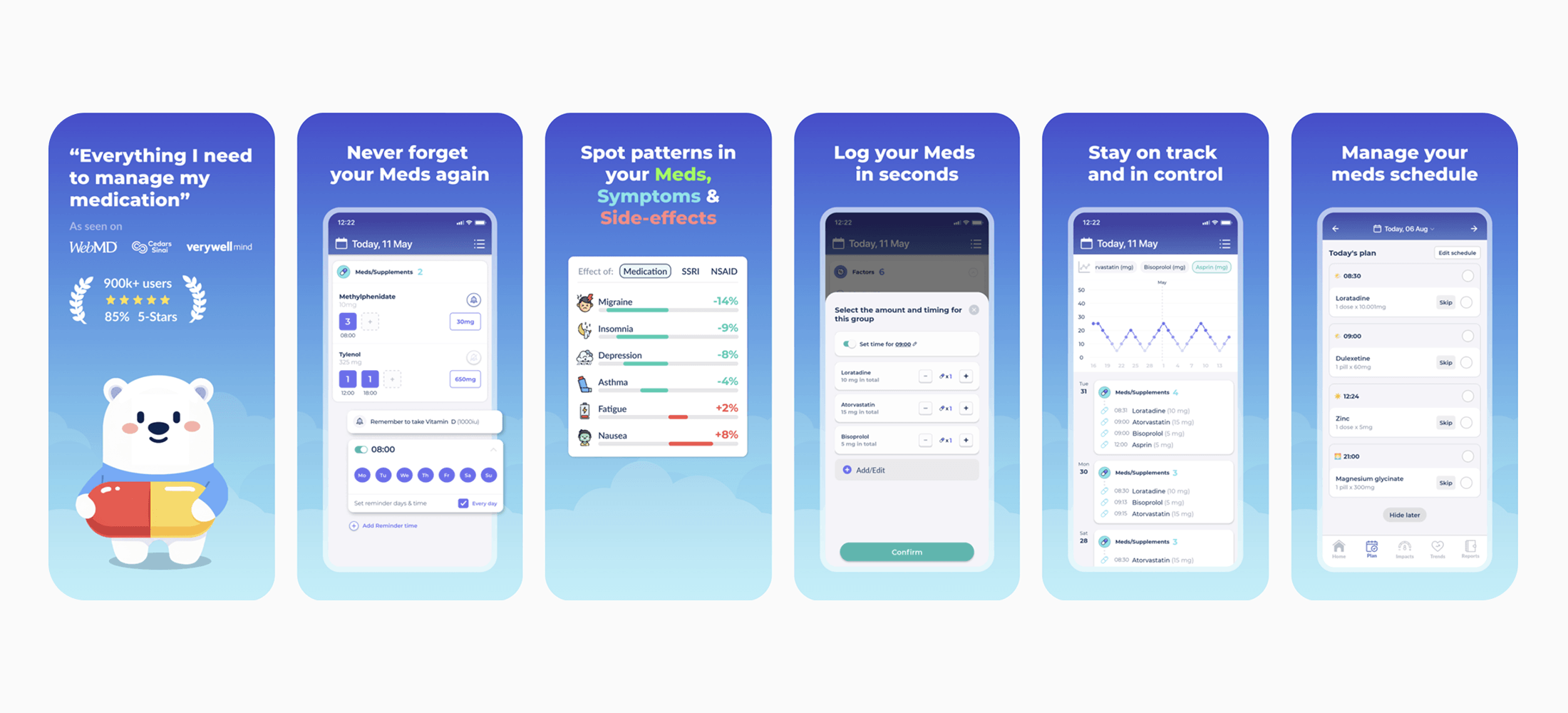
Price: Free; premium from $4.49. Platforms: iOS, Android. Standout: correlates medications with symptoms, side effects, and mood.
Bearable’s starting point is different from most of the apps on this list. Instead of treating medication tracking as an isolated checklist, it puts your medications on the same timeline as your symptoms, mood, sleep, energy, and dozens of other factors you choose to track. That means you can see, in a comparison graph, whether a medication is actually working, whether a new side effect lines up with when you started it, and how it interacts with everything else going on in your health, as laid out in Bearable’s own support documentation [11].
That makes it the strongest option here for anyone managing more than one condition at once, where the real question usually isn’t “did I take my pills” but “are they helping, and what are they costing me.” It’s the approach Bearable was built around for chronic illness generally. You can log multiple medications with flexible, fractional dosing, set reminders per medication or per day, group side effects into their own trackable category, and generate an advanced medication report to share with a doctor or specialist [11]. What Bearable does and doesn’t do with that data is spelled out in its privacy policy [12].
Key features:
Where it isn’t the best fit: if all you want is a simple pill alarm, Bearable’s breadth of tracking options can feel like more setup than you need on day one. Apps built purely around reminders, such as Medisafe, MyTherapy, or Apple’s own Health app, will get you a working reminder faster if correlation tracking isn’t what you’re after.
Price: Free; premium $2.99 to $9.99/month. Platforms: iOS, Android. Standout: drug interaction checker and caregiver “Medfriend” alerts.
Medisafe is the app most people have already heard of, and for good reason: it’s been in the medication reminder space for over a decade, has more than 101,000 ratings on its App Store listing at a 4.7-star average, and its interaction checker and refill alerts are genuinely useful if you’re on several prescriptions [13]. It syncs with Apple HealthKit, supports “Medfriends” so a family member or caregiver can get notified if you miss a dose, and lets you attach photos of your pills so you can tell them apart at a glance [13].
The tradeoff in 2026 is cost. Medisafe’s free tier has been trimmed down over the past year, and several of its more useful features (custom alarm sounds, unlimited caregiver notifications, and deeper customisation) now sit behind a subscription, with in-app pricing tiers currently running from $2.99 to $9.99 a month, or a one-time lifetime purchase, depending on which plan you’re offered [13].
Key features:
Pros vs Bearable: the largest and most established drug interaction database of any app on this list, plus caregiver notification features.
Cons vs Bearable: a limited free tier compared to what it used to include, and no meaningful way to correlate a medication with the symptom or side effect it’s actually affecting.
Price: Free. Platforms: iOS, Android. Standout: doctor-ready reports shared via a one-time code, with no ads.
MyTherapy manages to offer nearly everything Medisafe charges for, at no cost. It’s free across iOS and Android, rated 4.8 stars across 8,500 App Store reviews, and pairs medication reminders with a genuine health diary that tracks blood pressure, weight, blood sugar, mood, and symptoms alongside your medication log [14]. Its standout feature is how it handles doctor visits: MyTherapy can generate a secure, shareable report through a one-time code, so you don’t have to hand over your whole account to give a clinician the data they need [14]. The company points to research from Charité Universitätsmedizin Berlin backing its approach to improving adherence, and the app has stayed ad-free rather than working ads into the free tier the way some competitors have [14].
Key features:
Pros vs Bearable: completely free with no premium paywall, and a more clinically styled health diary that some users, and clinicians reviewing the reports, find easier to read at a glance.
Cons vs Bearable: its symptom tracking exists mainly to support the medication log, not the other way around, so it’s harder to spot patterns that involve mood, sleep, or the dozens of everyday factors Bearable tracks alongside medication.
Price: From $29.99/month on a 12-month prepaid plan up to $59.99/month with no commitment, plus the dispenser. Platforms: iOS and Android app, paired with the Hero smart dispenser. Standout: physically dispenses the right pills and alerts a caregiver if a dose is missed.
Hero is the only option on this list that isn’t purely software, and that’s exactly why it earns a place here. The Hero smart dispenser holds up to a 90-day supply of 10 different medications, sorts them, and dispenses the right combination at the scheduled time with an audible and visual alert; the person taking them presses one button. The companion app, rated 4.7 stars across roughly 10,000 App Store reviews, lets a caregiver set up schedules remotely, see in real time whether a dose was taken, and get an alert when one is missed or when a medication is running low [15]. Medications that don’t fit in the device (up to 10 more) can still be tracked in the app for reminders only [15].
The cost is the obvious catch. Forbes Health’s review puts pricing at $44.99 a month on a 12-month commitment, with a lower effective rate if you prepay annually, and Hero’s own site currently lists plans from $29.99 a month (12 months prepaid) to $59.99 a month with no commitment, alongside a 30-day money-back guarantee [20] [21]. Forbes also flags practical limits worth knowing about: the device can’t handle liquids, gummies, or refrigerated medications, and it has no battery backup during a power outage [20]. Some Medicare plans cover Hero through remote therapeutic monitoring programs, which is worth asking about before paying out of pocket [20].
Key features:
Pros vs Bearable: removes the “did they actually take it” question entirely for a family member who struggles with pill organisers, and gives a remote caregiver real visibility. Bearable is designed for one person tracking their own health, not for monitoring someone else.
Cons vs Bearable: a high recurring cost and a hardware commitment, no symptom or side-effect tracking, and it’s built for one household member rather than someone managing several conditions of their own.
Price: Free; EveryDose Plus premium tier. Platforms: iOS, Android, Apple Watch, Android Wear. Standout: built-in AI assistant for medication questions and up to five family profiles.
EveryDose is the newest entrant on this list to lean into AI as a core feature rather than an add-on. Alongside standard reminders, drug interaction alerts, and medication leaflets, it includes a built-in chat assistant (branded “Maxwell”) that users can ask general medication questions, and it offers weekly adherence summaries by email, according to its own features page [16]. It’s rated 4.8 stars on iOS and 4.5 on Android, with smartwatch support for both Apple Watch and Android Wear [16].
Its free tier covers the core reminder and interaction-alert functionality; EveryDose Plus adds tracking for 14+ additional health metrics and multi-profile family management for up to five people, which makes it a reasonable option for a household managing several people’s medications at once [16].
Key features:
Pros vs Bearable: built for managing multiple people’s medications from one account, which Bearable isn’t designed around, and a conversational interface some users find more approachable than manual logging.
Cons vs Bearable: an AI chat assistant is not a substitute for a pharmacist or doctor, and, as with any AI health tool, its answers are a starting point for a conversation with a professional rather than a replacement for one. It also doesn’t offer Bearable’s correlation reporting between medications and symptoms.
Price: Free. Platforms: iPhone, iPad, Apple Watch. Standout: already on your phone, with a US drug interaction database and follow-up reminders.
If you’re already an iPhone user and don’t need anything beyond solid reminders and interaction checking, Apple’s built-in Medications feature (part of the Health app since iOS 16) is genuinely good, and it costs nothing. You can log medications, vitamins, and supplements, set custom schedules including cyclical dosing, get follow-up reminders if you haven’t logged a dose within 30 minutes, and check for interactions using a US-specific drug database, all without installing a third-party app or creating another account, per Apple’s own support documentation [10].
The limitations are the ones you’d expect from a general operating-system feature rather than a purpose-built health app: there’s no way to track how a medication is affecting your symptoms, no caregiver notification system, and it only works within Apple’s ecosystem, so it’s not an option at all if anyone in your household uses Android [10].
Key features:
Pros vs Bearable: zero cost, zero setup beyond what’s already on your phone, and Apple’s privacy model keeps the data on-device and in your iCloud account rather than a third-party company’s servers.
Cons vs Bearable: iOS only, no symptom or side-effect correlation, and no way to share a structured report with a doctor beyond what you can screenshot or describe yourself.
A few names that used to show up in roundups like this one are no longer good recommendations. CareZone, once a popular caregiver-focused app, hasn’t been available for download since Walmart acquired it in 2020. We also left off apps we couldn’t verify were still actively maintained with a current app store presence in 2026. If an app hasn’t been meaningfully updated in a few years, that’s a reasonable reason to be cautious, even if it once had a good reputation.
Yes, with a caveat. A 2020 meta-analysis of nine randomized controlled trials found app users were about twice as likely to stay adherent to their medication regimen as non-users, though the underlying studies relied on self-reported adherence rather than objective measures like blood levels [1] [3].
It depends on your situation. If you’re managing more than one condition, the ability to see how a medication connects to your symptoms and side effects, rather than just whether you took it, is the feature that will actually change how you and your doctor make decisions. If you’re on a single, simple medication schedule, a straightforward reminder app or Apple’s built-in Health feature will likely be enough.
Most consumer medication apps are not covered by HIPAA the way your doctor’s office or pharmacy is; that protection generally applies to healthcare providers, insurers, and their business associates, not to a health app you download yourself. The FTC has stepped in to fill some of that gap. Its updated Health Breach Notification Rule, in effect since 2024, requires apps holding medication and health data to notify users if that data is exposed, and its 2023 enforcement action against GoodRx, fined $1.5 million for sharing medication and health condition data with advertisers, is a clear example of what can go wrong when an app doesn’t take that seriously [18] [19]. It’s worth reading any app’s privacy policy before entering your full medication list, and being cautious about which permissions you grant.
No, and none of the apps on this list claim to. Every one of them, including Bearable, includes some version of the same disclaimer: the insights they provide are meant to support a conversation with a healthcare professional, not replace one [11]. If you’re on several medications, Harvard Health’s advice still holds up well in the app era: ask your doctor or pharmacist whether your regimen can be simplified, and fill prescriptions at one pharmacy where possible so a pharmacist can catch interactions across your whole medication list [2] [6].
Caregiver-specific features matter here more than anything else. Look for an app that supports multiple profiles or sends you a notification when a dose is missed, and consider whether a physical dispenser makes sense if pill organisers aren’t working. Hero is built specifically for this (it dispenses the pills and alerts you remotely), Medisafe’s Medfriend feature and EveryDose’s family profiles cover the software-only version, and Bearable and MyTherapy can be used this way but are designed primarily around a single person managing their own health.
Bearable is patient-owned and run. However, if you’re specifically managing a rheumatic or autoimmune condition, it’s worth knowing about PatientSpot, run by the Global Healthy Living Foundation (formerly known as ArthritisPower). It’s not a general medication tracker in the same sense as the apps above; it’s built around patient-reported outcomes and research participation for conditions like rheumatoid arthritis and psoriatic arthritis. But it’s a credible, patient-advocacy-backed option if that’s your situation, and it’s worth mentioning precisely because most “best of” lists for this category skip patient-organisation tools entirely in favor of commercial apps [17].
Start from the actual problem you’re trying to solve, not the app with the biggest name. If you’re managing multiple health conditions and want to understand whether your medications are working, not just whether you remembered to take them, Bearable is built specifically for that. If you want the most established reminder-and-interaction-checker with a track record, Medisafe is hard to beat, price aside. If cost matters and you still want a comprehensive tool, MyTherapy gives away almost everything for free. If you’re looking after someone else and pill organisers aren’t cutting it, Hero’s dispenser is the most reliable answer, if the subscription fits your budget. And if you just need a dependable pill alarm and you’re already living in Apple’s ecosystem, the Health app on your phone will probably do the job without you downloading anything else at all.
Whatever you choose, the research is consistent on one point: a system, any system, that helps you see your medications clearly beats trying to hold it all in your head, especially once more than one condition and more than one prescription enter the picture [1] [3] [5].
“As someone with multiple chronic and complex conditions (including EDS, PoTS, PMDD), I’ve tried a lot of different health tracking apps. I was never able to use any consistently for more than a few weeks. They were too complicated, or didn’t track what was important to me, or all of the interesting features were behind a paywall. With Bearable, I’ve been able to consistently track my health and what impacts it for months.” – Taylor, Bearable member

Use your phone’s camera to scan and download the Bearable app. Available on iOS and Android devices.
Become the architect of your health.