

Published on August 12th 2026
Written by Jesse Driessen
Looking for a quick answer? The best period tracker app in 2026 depends on what you need most. Bearable is the best choice for people who want to understand how their cycle interacts with symptoms, mood, and chronic health conditions. Clue remains the best science-backed tracker, Flo has the most features, Euki is the best app for absolute privacy, Natural Cycles is the only FDA-cleared birth control app, and Apple’s built-in Cycle Tracking is the best option for wearable users.
If you want the full picture, read on. A lot has changed since we reviewed the best period tracker apps of 2025. A US jury ruled against Meta for collecting period tracking data. Mozilla published hands-on privacy testing of the biggest cycle tracking apps. Apple’s Health app started telling users when they might be in perimenopause. And AI has crept into almost every tracker on the market, which raises new questions about accuracy and trust.
This guide answers the questions people are actually asking about period tracker apps right now, then reviews the top six apps in detail.
Here’s how our six recommendations stack up at a glance. Privacy scores come from Mozilla’s 2026 hands-on testing; apps marked “not tested” weren’t part of that review.
App | Best for | Price | Where your data lives | Mozilla score | Platforms |
|---|---|---|---|---|---|
Bearable | Symptoms and chronic conditions | Free + premium | Encrypted backup, UK company (GDPR) | Not tested | iOS, Android |
Clue | Science-backed tracking | Free + Clue Plus | Company servers, Berlin (GDPR) | 8/10 | iOS, Android |
Flo | Features across life stages | Free + premium | Company servers, optional Anonymous Mode | 7/10 | iOS, Android |
Euki | Absolute privacy | Free | On your phone only | 10/10 | iOS, Android |
Natural Cycles | Hormone-free birth control | Subscription | Company servers, Sweden (GDPR) | Not tested | iOS, Android |
Apple Cycle Tracking | Wearable users | Free | On device, end-to-end encrypted iCloud | Not tested | iPhone only |
Every ranking here is based on evidence we can point to, not sponsorship. Nobody paid for placement, and there are no affiliate links in this article. We weighed four things: independent privacy testing, primarily Mozilla’s 2026 review; regulatory and legal history, from FTC enforcement actions to court rulings; the quality of each app’s medical sourcing and clinician involvement; and real user feedback from app stores and communities. Bearable is our own app, so we’ve disclosed that openly, ranked it for the specific use case it wins on, and been clear about where competitors beat us. And when an app fails independent testing, we remove it and say so, which is exactly what happened to one of our 2025 picks further down this page.
The short answer: prediction accuracy, symptom tracking depth, and a privacy design you can verify rather than take on faith.
Not long ago, most people chose a period tracker based on design and prediction accuracy. In 2026, privacy architecture matters just as much, because researchers have repeatedly caught apps sharing intimate data with third parties. Mozilla’s 2026 privacy review of period and ovulation apps found that some apps still fold reproductive health details into advertising profiles, and that others market themselves as “encrypted sanctuaries” while offering only standard protections.
Here’s what we’d prioritise when comparing apps in 2026:
A period tracker turns your cycle into usable health data. The American College of Obstetricians and Gynecologists recommends treating the menstrual cycle as a vital sign, on par with blood pressure or heart rate, because changes in cycle length, flow, and associated symptoms can be early indicators of underlying conditions.
In practice, that means a good tracking app can help you predict your period and plan around it, identify patterns between your cycle and symptoms like migraines, fatigue, or low mood, give your doctor months of accurate history instead of guesswork, flag changes that deserve a medical conversation, and monitor whether a new medication or lifestyle change is actually helping.
That last point is where tracking gets underrated. Anyone managing PMDD, endometriosis, PCOS, or perimenopause knows the frustration of being asked “and how long has this been happening?” in a ten-minute appointment. A detailed log answers that question with data.
For most mainstream apps, your data is more protected than it was five years ago, but “private” still depends on where the company stores it and where the company is based.
The stakes became very real in August 2025, when a California jury ruled that Meta violated state privacy law by collecting intimate health data from users of the Flo app through an embedded software development kit. Flo itself, along with Google and Flurry, later agreed to a combined $59.5 million settlement over the same data sharing practices, which dated back to 2016 through 2019. Millions of users learned that data they logged in confidence had been used for advertising.
This worry is well documented. A peer-reviewed study by Duke University researchers, which surveyed 183 women across US states with different abortion laws, found widespread concern about period-tracking data being accessed by law enforcement and third parties, and reported that many participants felt uninformed and powerless to reduce the risk. Researchers writing in The Lancet have raised similar concerns about menstrual tracking apps and data privacy. The practical point is simple: data stored on a US company’s servers can be subpoenaed. Data stored only on your phone, or held by a company outside US jurisdiction, is much harder to reach. One Reddit commenter in r/TwoXChromosomes put it bluntly when recommending a European app: “They’re based in Germany and so their data is red-state safe.”
So before you trust an app, check three things: where the company is registered, whether your data ever leaves your device, and whether the app has a published policy on responding to law enforcement requests.
Euki is the standout here. It stores everything locally, requires no account, and earned a perfect 10/10 in Mozilla’s 2026 privacy testing, which concluded that “there’s almost nothing to leak” because the app simply never sends your data anywhere.
Local-only storage is the strongest privacy guarantee available, but it comes with trade-offs. If you lose your phone, you lose your history. There’s no syncing across devices, and features that depend on cloud processing, like AI-driven insights, aren’t possible.
Other apps take a middle path. Flo offers an Anonymous Mode that strips your account of identifying information, and the company has open-sourced the feature for independent scrutiny. Bearable encrypts user data, is registered in the UK under GDPR rather than in the US, and has a plain-English commitment to never sell user data. Clue, based in Berlin, is likewise covered by GDPR and gives users granular consent controls over analytics and research uses of their data.
The honest summary: choose local-only storage if privacy is your single highest priority, and choose an encrypted, GDPR-covered app if you want privacy plus insights and backups.
No app can diagnose PCOS or endometriosis, and you should be wary of any that implies it can. What AI-assisted trackers can genuinely do is spot patterns in your logged data that are worth raising with a doctor.
That distinction matters more than it sounds. Diagnosing PCOS requires clinical assessment, typically including blood tests and an ultrasound, as the NHS explains. Endometriosis is even harder, with Endometriosis UK reporting an average diagnosis time of almost nine years in the UK. A tracker that surfaces months of evidence, like consistently irregular cycles, severe pain clustered around ovulation, or symptoms that flare in your luteal phase, can shorten the road to diagnosis by giving your GP something concrete to act on.
One caveat on accuracy: AI prediction models perform best on regular cycles, because they need consistent patterns to learn from. If your cycle is irregular, which is common with PCOS and during perimenopause, treat any app’s predictions as rough estimates rather than reliable forecasts, whatever the marketing says.
This is also where a symptom-first tracker earns its keep. Apps built around period prediction treat pain and fatigue as add-ons. Apps built around symptom tracking, like Bearable, treat them as primary data, which is exactly what a diagnostic work-up needs.
As of this year, some genuinely try. In June 2026, Apple added a feature to the Health app that tells users if they may be in perimenopause, based on cycle history, age, and logged symptoms. It’s a significant moment for a category that spent a decade assuming every user was either avoiding pregnancy or trying to conceive.
The medical reality is that perimenopause can’t be confirmed by an algorithm alone. The NHS notes that it’s usually identified from symptoms, like changes to cycle regularity, hot flushes, sleep disruption, and mood changes, and that the transition commonly lasts years. Blood tests are only recommended in certain cases.
What an app can do brilliantly is document the transition. Perimenopause symptoms are notoriously scattered, affecting sleep, mood, joints, skin, memory, and cycles all at once, and they’re easy to dismiss individually. Tracking them together, alongside your cycle, HRT doses, and lifestyle factors, builds the picture that gets taken seriously in a consultation. If you’re evaluating apps for this stage of life specifically, look for flexible custom symptom tracking rather than fertility-focused features you’ll never use.
Wearables have earned a real place in cycle tracking, with one important boundary: only one app is actually cleared to be used as contraception.
Natural Cycles was the first app cleared by the FDA as a digital birth control, and it now works with skin temperature data from Apple Watch and Oura Ring instead of daily manual thermometer readings. The company received its sixth FDA clearance for a next-generation fertility algorithm in 2026. No other period tracker’s “fertile window” predictions are regulated for pregnancy prevention, so don’t use a standard tracker as contraception regardless of how confident its calendar looks.
For general cycle awareness, wearable temperature and heart rate data can improve predictions, and passive tracking suits people who won’t reliably log every day. Apple Watch users get retrospective ovulation estimates from wrist temperature, and Oura offers cycle insights through its own AI model. Just remember that all fertility awareness methods depend on consistent use, and typical-use effectiveness is meaningfully lower than perfect-use effectiveness, a distinction the American College of Obstetricians and Gynecologists explains well.
The evidence is thinner than your TikTok feed suggests. Cycle syncing, the idea that you should schedule specific workouts and foods to each phase of your cycle, exploded on social media, and several big apps now sell phase-based training plans. But a review published in Frontiers in Sports and Active Living found that the research base is limited and inconsistent, with hormone responses varying so much between individuals that generic phase-based prescriptions aren’t currently supported by the science.
That doesn’t make cycle awareness useless. Plenty of people notice real differences in energy, strength, and recovery across their cycle. The evidence-based approach is to track your own symptoms and performance and adjust to your own patterns, rather than following a one-size-fits-all plan built for an average cycle that may not resemble yours. Your data beats the template.
We’ve reviewed and rated the top six apps below. Yes, Bearable is our app, so we’ve put our cards on the table first, but we’ve been honest about where each competitor beats us. Every app here is a genuinely good choice for the right person.
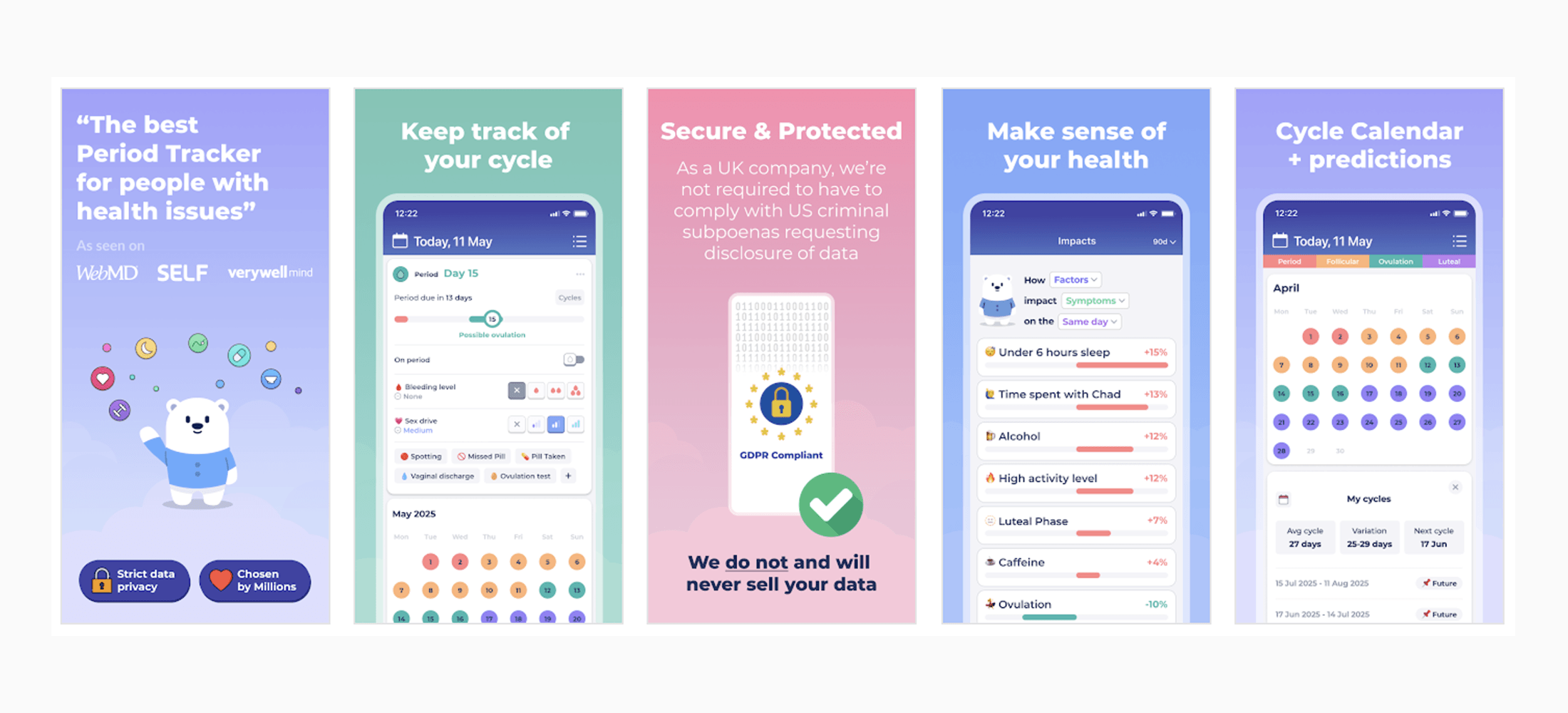
Bearable is built for people whose cycle is one piece of a bigger health puzzle. Alongside period tracking, it lets you log symptoms, mood, medications, sleep, energy, diet, and any custom factor you can think of, then shows you how those factors correlate with your cycle across 30+ reports. That makes it particularly useful for people managing endometriosis, PCOS, PMOS, PMDD, Migraine, or Perimenopause, where the question isn’t just “when is my next period?” but “why do I feel like this, and what helps?”
Choose Bearable if you’ve ever felt like your period app, your mood app, and your pain diary should be talking to each other. Because everything lives in one log, Bearable can answer questions single-purpose trackers can’t, like whether your migraines cluster in your luteal phase or whether a new medication is easing your PMS. It grew popular in chronic illness communities for exactly this reason, and it works just as well for anyone who wants to understand their body rather than just predict a date.
On privacy, Bearable is UK-registered and GDPR-compliant, doesn’t require identifying details like your name, encrypts user data, and commits to never selling it. Bearable’s privacy policy also notes that, as a UK company, it is not required to comply with US criminal subpoenas requesting disclosure of data. It holds 4.7 stars on the App Store and 4.6 on Google Play, with a community of over 900,000 people.
Key features:
Pros: the deepest symptom and correlation tracking of any app on this list, strong privacy posture outside US jurisdiction, highly customisable, works well alongside wearable data.
Cons: period prediction is not its core focus, so dedicated cycle apps offer richer fertility features, and the depth of tracking options can feel like a lot on day one.
Clue remains the app to beat for evidence-based cycle tracking. It’s run from Berlin under GDPR, co-created with researchers, and its in-app content is medically reviewed and refreshingly free of pink-washed fluff. Mozilla’s 2026 testing scored it 8/10 for privacy, with credit for granular consent controls that let you separately opt out of analytics, advertising, and research.
Clue is the app for people who want to trust what their tracker tells them. Its content links back to research, the in-app library reads like a well-edited health encyclopedia, and its predictions are honest about uncertainty rather than pretending to day-perfect accuracy. Clue has also grown up with its users, adding dedicated modes for conception, pregnancy, and perimenopause, so it adapts as your needs change instead of assuming everyone is trying to conceive.
Key features:
Pros vs Bearable: stronger cycle science pedigree, better fertility and ovulation features, and published research collaborations.
Cons vs Bearable: symptom tracking is broad but shallower, with no equivalent of Bearable’s cross-factor correlation reports for conditions like PMDD or chronic pain, and the best features sit behind the Clue Plus subscription.
Flo is the biggest name in the category, and its feature set shows it: cycle and ovulation prediction, pregnancy mode, perimenopause mode, symptom logging, and an enormous content library. Its privacy story is complicated. The 2016 to 2019 data sharing that led to the Meta verdict and the $59.5 million settlement is exactly why sceptics exist, but it’s fair to say today’s Flo is a different operation, with an open-sourced Anonymous Mode and a 7/10 score in Mozilla’s 2026 review.
Flo makes sense if you want the most complete feature set in a single app and a gentle learning curve. Setup takes minutes, the interface explains itself, and daily insights keep casual users engaged in a way sparser apps don’t. It also scales across life stages, from first periods through pregnancy to perimenopause, and its anonymous community spaces let you compare notes with people at the same stage. For a mainstream, do-everything tracker, it’s the benchmark.
Key features:
Pros vs Bearable: more polished fertility and pregnancy features, huge medically-reviewed content library, and Anonymous Mode is a genuine privacy innovation.
Cons vs Bearable: its history means trust is still rebuilding, it remains a heavily analytics-driven platform, and symptom tracking is designed around the cycle rather than your wider health.
Euki is the app privacy experts recommend, and the only one Mozilla has ever scored a perfect 10/10. It’s open source, run by a nonprofit, requires no account, and stores every entry on your device. It even lets you set a decoy PIN screen for situations where someone demands to see the app.
Euki is the pick when you want tracking with no digital footprint at all. It was built by reproductive health nonprofits specifically for people who may face legal or personal risk, and every design decision follows from that: no account, no server, a decoy screen, and the option to delete your data automatically on a schedule. It also includes clear, medically reviewed information on contraception, abortion, and sexual health, which makes it more useful than its minimalist tracking alone would suggest.
Key features:
Pros vs Bearable: the strongest privacy design on the market, full stop. Nothing leaves your phone.
Cons vs Bearable: no cloud backup, so your history dies with a lost phone, no correlation insights or AI features, and the tracking itself is basic compared to a dedicated symptom tracker.
Natural Cycles is in a category of one: it’s the only period app FDA-cleared as birth control, now on its sixth clearance, and it pairs with Apple Watch and Oura Ring so temperature tracking happens while you sleep.
Natural Cycles is for people whose main goal is contraception without hormones, backed by a regulator rather than a marketing team. According to Natural Cycles’ clinical data, it is 93% effective with typical use and 98% with perfect use, and unlike a generic tracker it is legally allowed to call itself birth control. It suits people with reasonably consistent routines who will wear their ring or watch nightly, and it doubles as a planning tool when you’re ready to conceive.
Key features:
Pros vs Bearable: regulated contraception is something no other app on this list can legally offer, and its wearable integrations are best in class.
Cons vs Bearable: it’s a single-purpose subscription app, symptom tracking is minimal, and it’s only suitable if you’re comfortable with the real-world failure rate of fertility awareness methods.
Apple’s Cycle Tracking in the Health app has quietly become excellent, especially if you own an Apple Watch, which adds wrist-temperature ovulation estimates. The June 2026 update added perimenopause insights, and Health data is end-to-end encrypted when you use iCloud with two-factor authentication.
Apple’s built-in option suits anyone who wants solid tracking with zero extra effort or cost. There’s nothing to install, no new account to create, and if you wear an Apple Watch the most useful data arrives passively while you sleep. Apple’s scale also means features like cycle deviation alerts and perimenopause insights reach a huge number of people by default. It won’t dig into symptoms the way a dedicated app will, but as a baseline it’s hard to beat.
Key features:
Pros vs Bearable: free, already on your iPhone, passive wearable data collection, and strong encryption by default.
Cons vs Bearable: iPhone-only, symptom logging is rigid with no custom factors, and there’s nothing like Bearable’s correlation reports to connect your cycle to the rest of your health.
A few well-known apps were left out on purpose, and you deserve to know why.
Stardust featured in our 2025 review, but it dropped off this list after Mozilla’s 2026 testing observed it transmitting symptom data with timestamps to third-party analytics tools, the most direct data sharing of any app tested, and scored it 2/10 for privacy. Spot On, Planned Parenthood’s tracker, scored a middling 5/10 in the same testing after researchers watched its in-app web pages expose location, age, and menstrual dates to analytics vendors.
Premom, a popular ovulation tracker, was barred by the FTC in 2023 from sharing users’ health data for advertising, after regulators found it had passed sensitive information to third parties, including two China-based analytics firms, without consent. Glow reached a $250,000 settlement with the California Attorney General in 2020 over security failures that risked exposing users’ personal and medical information.
Finally, the simple calendar-style apps. Mozilla found Period Calendar sending device identifiers and advertising signals to Google and InMobi, a reminder that even apps which never touch your cycle data directly can leak revealing metadata. My Calendar, which we featured in 2025, hasn’t faced findings like that, but the no-frills niche it serves is now covered more safely by Euki and Apple’s built-in Cycle Tracking.
Start from your main problem, not from an app store chart. If you want to understand how your cycle connects to symptoms, mood, medication, or a chronic condition, choose Bearable. If you want the most rigorous cycle science, choose Clue. If you want maximum features and accept the history, choose Flo. If privacy overrides everything, choose Euki. If you want hormone-free contraception, Natural Cycles is the only regulated option. And if you just want solid, private, no-effort tracking on an iPhone, Apple’s built-in Cycle Tracking is better than most paid apps.
Whichever you pick, check where your data lives before you log a single symptom. As the past year’s court rulings proved, that decision matters more than any feature.
“As someone with multiple chronic and complex conditions (including EDS, PoTS, PMDD), I’ve tried a lot of different health tracking apps. I was never able to use any consistently for more than a few weeks. They were too complicated, or didn’t track what was important to me, or all of the interesting features were behind a paywall. With Bearable, I’ve been able to consistently track my health and what impacts it for months.” – Taylor, Bearable member
Use your phone’s camera to scan and download the Bearable app. Available on iOS and Android devices.
Become the architect of your health.